Gestures
What to do with your hands when presenting, and how to check on camera
Give your hands a home at navel height, gesture on the word that matters, and use the camera to check what they actually do. This is craft, not mind-reading.
· 8 min read · The StageMirror team

What to do with your hands when presenting has a short answer. Rest them loosely in front of you at about navel height, elbows a little off your ribs. Gesture from there when a word needs it (a number, a size, a contrast), then let them come back. Keep them out of your pockets and inside the frame. Then check: you can’t feel where your hands are while you talk, but a muted recording shows you in a minute.
Why you don’t know what to do with your hands when presenting
At a table your hands have jobs: a cup, a pen, a keyboard. On your feet they have none, so you park them. Pockets, folded arms, a clasp behind your back, a grip on the clicker. Each takes your hands out of use for the rest of the talk.
Pinning them still is the wrong fix. When Rauscher, Krauss and Chen stopped speakers gesturing as they described cartoons, their speech about spatial content became less fluent; the rest didn’t change. Goldin-Meadow and colleagues found that people explaining a maths problem while holding a list in memory recalled more of the list when they gestured.
Listeners gain too. Autumn Hostetter’s 2011 meta-analysis of 63 samples found that speech with gestures was understood moderately better than speech alone, more so when the gestures added something the words didn’t. So the aim isn’t still hands. It’s hands with a home, and a job when a word calls for one.
The zones: below the hips, the TruthPlane, chest height and above
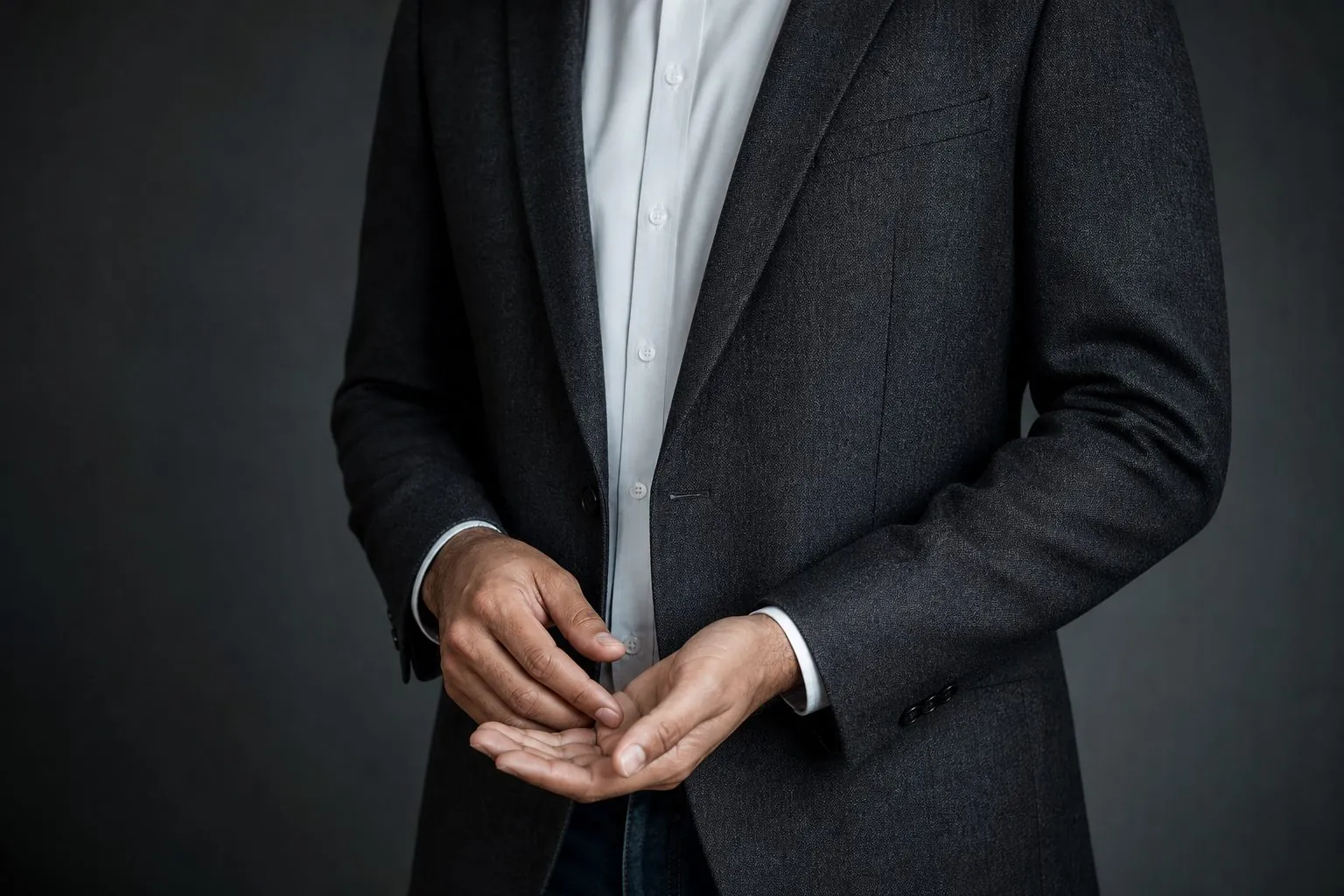
Coaches often split the space in front of you into horizontal bands. The best-known version is Mark Bowden’s: he calls the plane extending out from your navel the TruthPlane and argues that open-palm gestures there make an audience trust you. That’s a coach’s claim, and we don’t lean on it. The plainer case: hands there are visible, relaxed, and one short movement from any gesture.
| Zone | Where your wrists are | Good for |
|---|---|---|
| Below the hips | Arms hanging | A brief rest. On camera, hands there leave the frame. |
| TruthPlane | Hip line to lower chest | Home base and most gestures. |
| Chest height | Lower chest to shoulders | The few lines you want to land harder. |
| Above the shoulders | Hands raised high | Rare and literal: height, growth, a show of hands. |
Gesture on the noun, not through the whole sentence
Researchers break a gesture into phases: the hand gets ready, makes the movement that carries the meaning (the stroke), may hold, then returns. David McNeill describes the other phases as arranged so the stroke lands with the words that express the same idea. So decide which word a gesture belongs to, and put the movement there.
Usually it’s a noun or a number. “We cut onboarding from three weeks to two days.” Hands wide apart on “three weeks”, close together on “two days”, then home. The rest of the sentence is still.
The common failure is a hand that pumps on every stressed word, or circles through the whole sentence. When everything moves, nothing stands out. Gestures that show something earn their place:
- Size. Hands apart for big, close for small.
- Comparison. One option in each hand.
- Sequence. Three steps counted on your fingers.
- Direction. A rising line for growth, the one good reason to go above the shoulders.
Let the hands come home in the pause that replaces an “um”: stop talking, hands home, next sentence.
Hands on video: get them in the frame
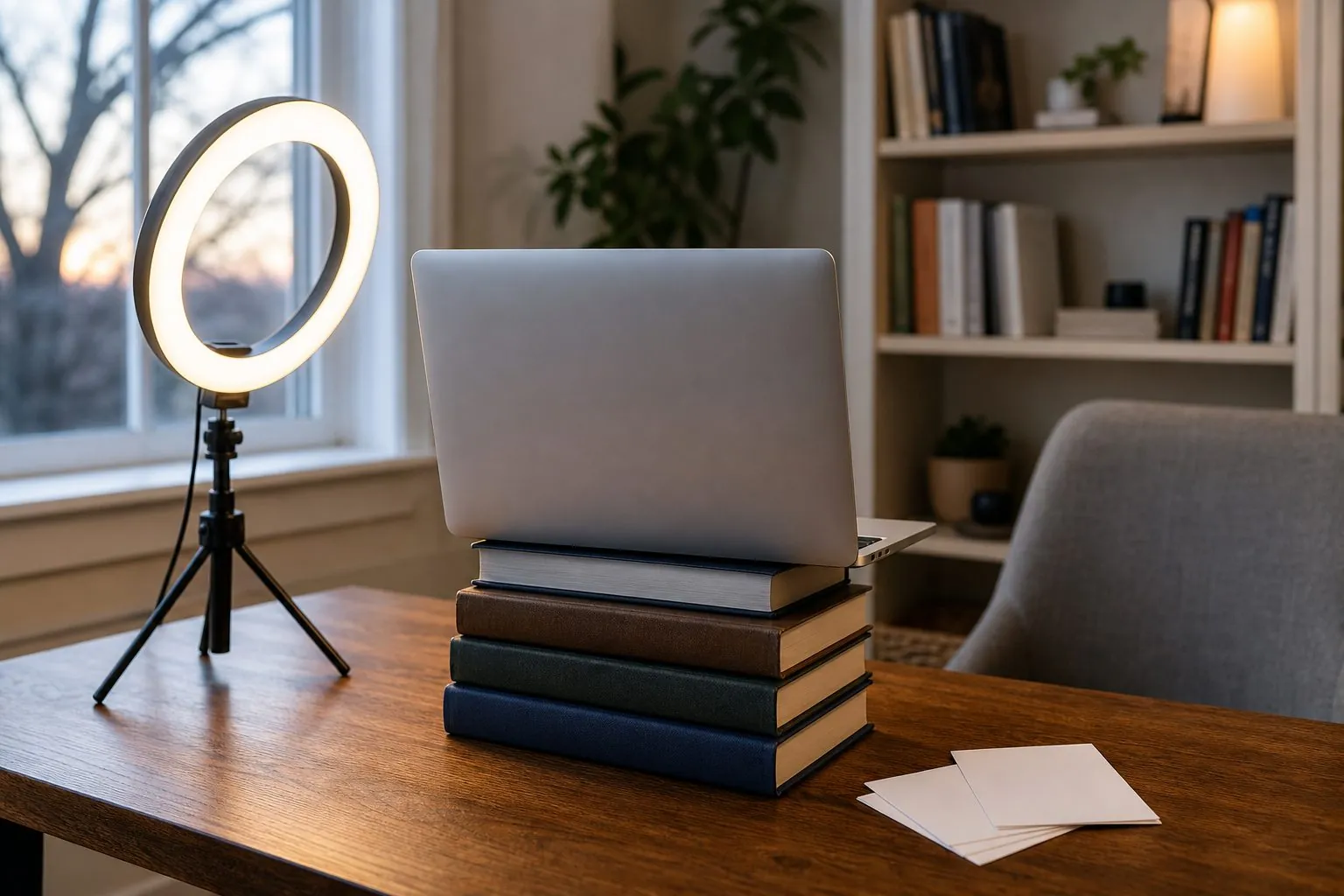
On camera, the frame decides. A laptop at desk distance shows little more than head and shoulders, so hands at navel height sit below the edge. Sit further back, or, on a tight crop, gesture at chest height and within shoulder width.
Rehearse in a wider frame than you’ll pitch in. Put the phone at eye height and step back until your face and your hands at navel height are both in shot, roughly mid-thigh up. Record ten seconds and check your palms aren’t clipped. If they are, move the phone, not your hands. Lens height and gaze are covered in eye contact on camera.

Before you record
- Camera at eye height, on something solid.
- Framed from mid-thigh up, hands at navel height in view.
- Light in front of you, nothing bright behind.
- Pockets empty; clicker and notes put down.
Then watch the take muted: you see only where the hands wait, when they move, and whether each movement lands on its word. It’s the first pass of the three-pass review.
A drill: home, stroke, home
How StageMirror estimates hand zone, gestures and posture
The free 14-Day Founder Speaker Intensive gives hands a day of their own. Day 6, “Hands find the TruthPlane”, has you check your palms are inside the frame and choose a resting position. Day 10, “Plant the feet”, adds a rule: one gesture per point, hands back to navel height, two seconds still. On the web, the Day 7 checklist includes “Hands reach the TruthPlane at least intermittently”, and Day 14 asks for “TruthPlane discipline”, at least half the take in the band, next to “Posture stable, minimal sway”.
Frequently asked questions
Where should I put my hands when presenting?
Loosely in front of you at about navel height, elbows a little away from your ribs, so any gesture is one short movement away. Pockets, folded arms and a tight clasp lock them away.
Is it bad to put your hands in your pockets when presenting?
It isn’t a character flaw, but it takes your hands out of use, and it’s awkward to get them out mid-sentence. If you need a rest, let your arms hang for a moment, then bring them back to navel height.
How many hand gestures should you use in a presentation?
There’s no right number. A gesture earns its place when it lands on its word and shows something the words don’t, such as a size or a comparison. StageMirror estimates a gesture rate per minute but sets no target for it.
What should I do with my hands on a video call?
Sit far enough back that a gesture at chest height shows in the frame, and keep gestures within shoulder width. Between gestures, keep your hands still rather than fidgeting at the bottom edge of the picture. Where to look on a call.
Do hand gestures make you look more confident?
StageMirror doesn’t score confidence, and we won’t guess at it here. The research supports narrower points. Gesturing has helped speakers stay fluent about spatial content and eased the load of explaining, and gestures that add information help listeners understand.
Sources
- Gesture, speech, and lexical access: The role of lexical movements in speech production — Rauscher, Krauss and Chen, Psychological Science 7(4), 1996
- Explaining math: Gesturing lightens the load — Goldin-Meadow, Nusbaum, Kelly and Wagner, Psychological Science 12(6), 2001
- When do gestures communicate? A meta-analysis — Autumn B. Hostetter, Psychological Bulletin 137(2), 2011
- Gesture (Cambridge Encyclopedia of the Language Sciences) — David McNeill, McNeill Lab, University of Chicago
- We trust what we see: improve your speaking and your speakers with winning body language — Mark Bowden, TruthPlane