Eye contact
Eye contact on camera: where to look when you pitch over video
On a call, the person you’re talking to sees your eyes through the lens, not through the face on your screen. Why our target is 60% to 70% rather than 100%, and a setup that makes the lens easy to hit.
· 9 min read · The StageMirror team

On a video call there is exactly one place where the other person can see you looking at them, and it isn’t on your screen. It is the small glass lens above it. Look at their face, which is where every instinct sends you, and if that face sits halfway down the screen, from their side you are looking down. Look at your notes and you look further down, like someone reading, because you are.
Should you look at the camera or the screen?
The lens, and the window you have to hit is smaller than it feels. In a 2025 paper in the Journal of Vision, Gao and colleagues summarise earlier studies that put the edge of perceived eye contact at about 4.5 degrees above the camera and 5.5 degrees below it. Their own experiment added a twist: the photographs that read most as eye contact weren’t the ones looking straight into the lens, but ones looking about two degrees below it. It is a small study, 17 viewers judging still photographs, and the authors expect the exact offset to shift with viewing distance, so take the direction rather than the decimal places.
Now some arithmetic of our own, not a finding. At 50 to 60 centimetres from a laptop, five degrees comes to roughly four or five centimetres. That is the whole budget. Whatever you need to look at while you speak has to sit within a few centimetres of the lens. Halfway down the screen is well outside it.
Expect this to feel wrong. Your eyes want the face. Jeremy Bailenson, of Stanford’s Department of Communication, lists “looking directly into the camera (as opposed to the faces on the screen)” among the cues video callers are forced to send deliberately, and argues that this constant monitoring adds up.

How much eye contact is right on a video call?
The obvious conclusion is to stare at the lens for the whole call. Don’t. Bailenson, summarising earlier work, notes that two people talking one to one still spend substantial parts of the conversation looking away from each other, and that when there is something else in the room to look at, they look at each other’s face less than half the time. Direct eye contact is used sparingly.
Unbroken gaze doesn’t read as more attentive, either. In a 2005 study Bailenson describes, two listeners in virtual-reality headsets shared a virtual room with a speaker whose head movements were redirected so that each saw direct, unwavering gaze for eight minutes. Listeners rated that condition lowest for social presence; they didn’t feel in tune with the speaker. It was avatars, not a video call, though Bailenson likens it to one.
How long is comfortable? In one study, nearly 500 visitors to London’s Science Museum watched clips of an actor looking out at them and judged whether the gaze felt too long or too short. The average comfortable length was about 3.3 seconds, give or take about 0.7. That is one study’s average, not a rule for pitching, but it is a useful corrective to “never look away”.
Looking away also does a job. Glenberg and colleagues found that people avert their gaze more as questions get harder, and that averting it improves their performance. So when an investor asks something difficult, glancing away to think is normal. What matters is where the sentence goes once you have the answer, which is the subject of answer, then stop talking.
That is why StageMirror’s target is a band, 60% to 70%, rather than a score to push to the top. The band is our own target, not a research figure. On the session screen, a figure a few points over the band gets the same amber flag as one a few points under it, and well over it turns red. The milestone checklists only set a floor: going over costs you nothing there, and earns you nothing either.

How to set up your camera for eye contact
Most of the fix is furniture. None of it costs anything.
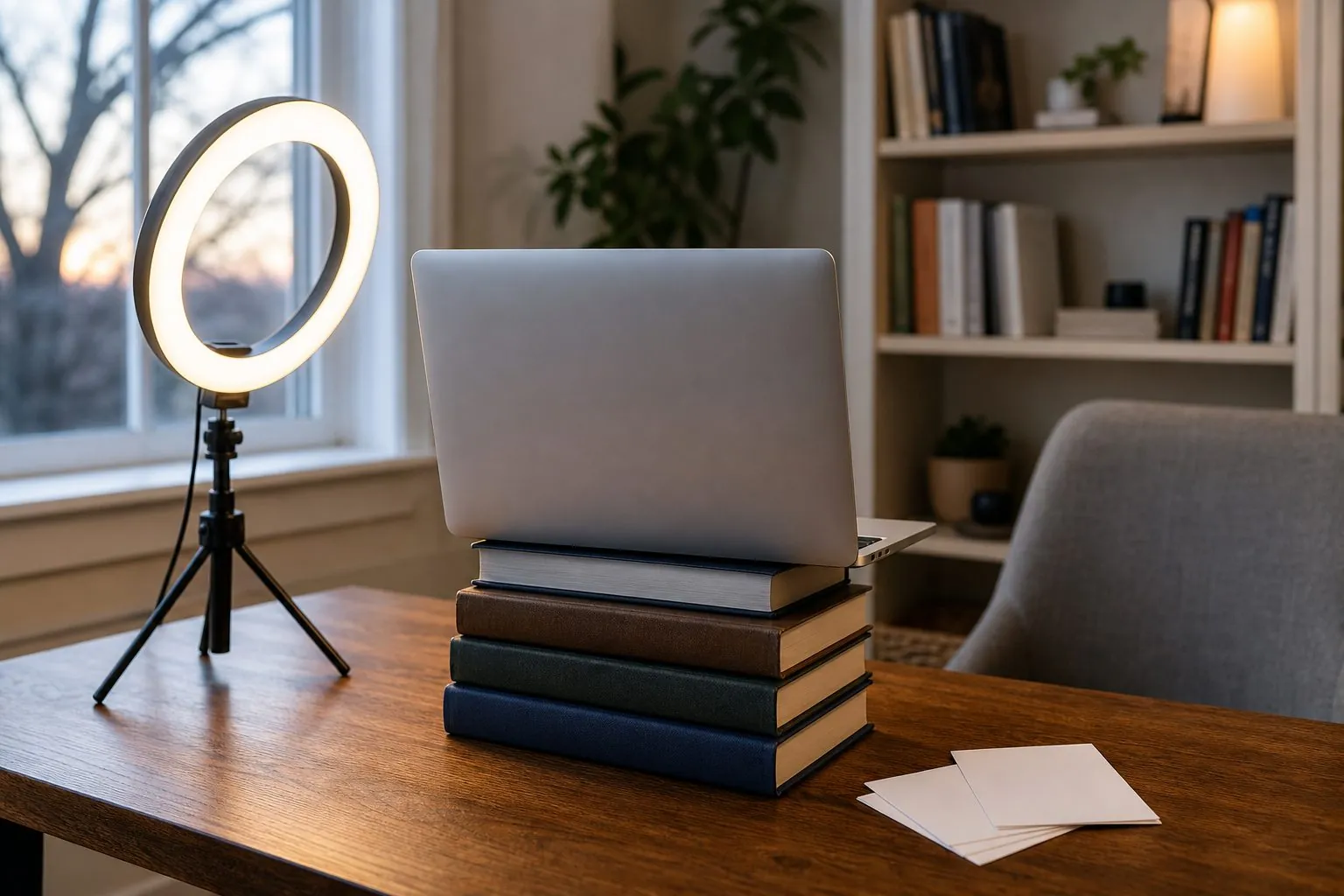
- Lens at eye height. Put the laptop on a stack of books, or the phone on a shelf. A lens below your chin turns every look at it into a glance down, and puts your face low in the frame.
- Move what you look at up to the lens. Drag the other person’s video tile to the top centre of the screen, directly under the camera, and put your notes there too, even if that means taping a card just below the lens. A smaller call window keeps the tile nearer the lens. If the research above holds, a face just under the lens costs you little, and may even read slightly better than the lens itself.
- Hide self-view. Most call software has the setting. Bailenson names self-evaluation from watching yourself as one of four possible causes of Zoom fatigue, and calls those four arguments, not findings. Your own face is also the most tempting thing on the screen, and it is never at the lens.
- Sit a little further back. The further you are from the screen, the smaller the angle between a tile and the lens. It also gets your shoulders and hands into the shot.
- Light from the front. A window or a lamp in front of you, nothing bright behind. A face lit from behind becomes a silhouette, and eyes in shadow are hard to read on a small tile. Low light and glasses also make StageMirror’s gaze estimate less reliable.
One caveat about our own product. StageMirror’s teleprompter sits along the bottom of the camera preview, on the web and on the phone, the opposite end from a lens at the top. Use it like notes: glance at the next line in a pause, lift your eyes, then speak. Or switch it off; both studios have a toggle.
What an eye-contact number can and can’t tell you
Be clear about the precision. StageMirror’s analysis assumes that gaze read from face landmarks, without calibrating to your eyes, can be off by something like 5 to 10 degrees, about the size of the whole window in the research above. So it is designed to register the bigger moves: a head turned to a second monitor, a long look down at notes at the bottom of the screen. A glance at a face tile or your own preview a few centimetres under the lens sits inside its margin of error.
It also runs over the whole take, silences included. Look away for three seconds while you think and the figure drops, exactly as if you had looked away mid-sentence, which is one more reason the target stops well short of 100%. The number counts frames. It has no idea what you were looking at, or why.
A drill: one sentence to the lens
Eye contact on camera is a habit you build one sentence at a time. This takes about fifteen minutes and needs a phone and a stack of books.
This is a compressed version of Day 5 of the 14-Day Founder Speaker Intensive, which runs on the web and in the phone app. That day is titled “One sentence, said to the lens”. Its warm-up has you set the phone at eye height, hold your eyes on the lens rather than your own image, rest them on something six metres away, then say a tongue twister to the lens, restarting any line your eyes leave.
The milestones, scored on the web, pick it up. The Day 7 checklist includes “Eye contact estimated at 50% or better”, and Day 14 raises the bar to 60% or better, both recomputed on the server from the stored analysis. The day-by-day plan covers the rest of the fortnight.
When you bank the day’s take, on the web or the phone, one of its optional reflection questions is worth asking after any practice run. Find the longest stretch where your eyes were off the lens, and name what you were doing in it: reading, thinking, or watching yourself. Thinking is fine. The other two are fixed by the setup above.
Sources
- Don’t look at the camera: Achieving perceived eye contact in remote video communication — Gao, Jayakumar, Maniglia, Curless, Kemelmacher-Shlizerman, S. Seitz and A. Seitz, Journal of Vision 25(11):8, 2025
- Nonverbal Overload: A Theoretical Argument for the Causes of Zoom Fatigue — Jeremy N. Bailenson, Technology, Mind, and Behavior (American Psychological Association), 2021
- Pupil dilation as an index of preferred mutual gaze duration — Binetti, Harrison, Coutrot, Johnston and Mareschal, Royal Society Open Science, 2016
- Averting the gaze disengages the environment and facilitates remembering — Glenberg, Schroeder and Robertson, Memory & Cognition, 1998