Self-review
How to practise a presentation alone: the three-pass method
Watching yourself once mostly produces “I hate my voice”. Taking away one channel per pass is what makes a self-review useful.
· 8 min read · The StageMirror team
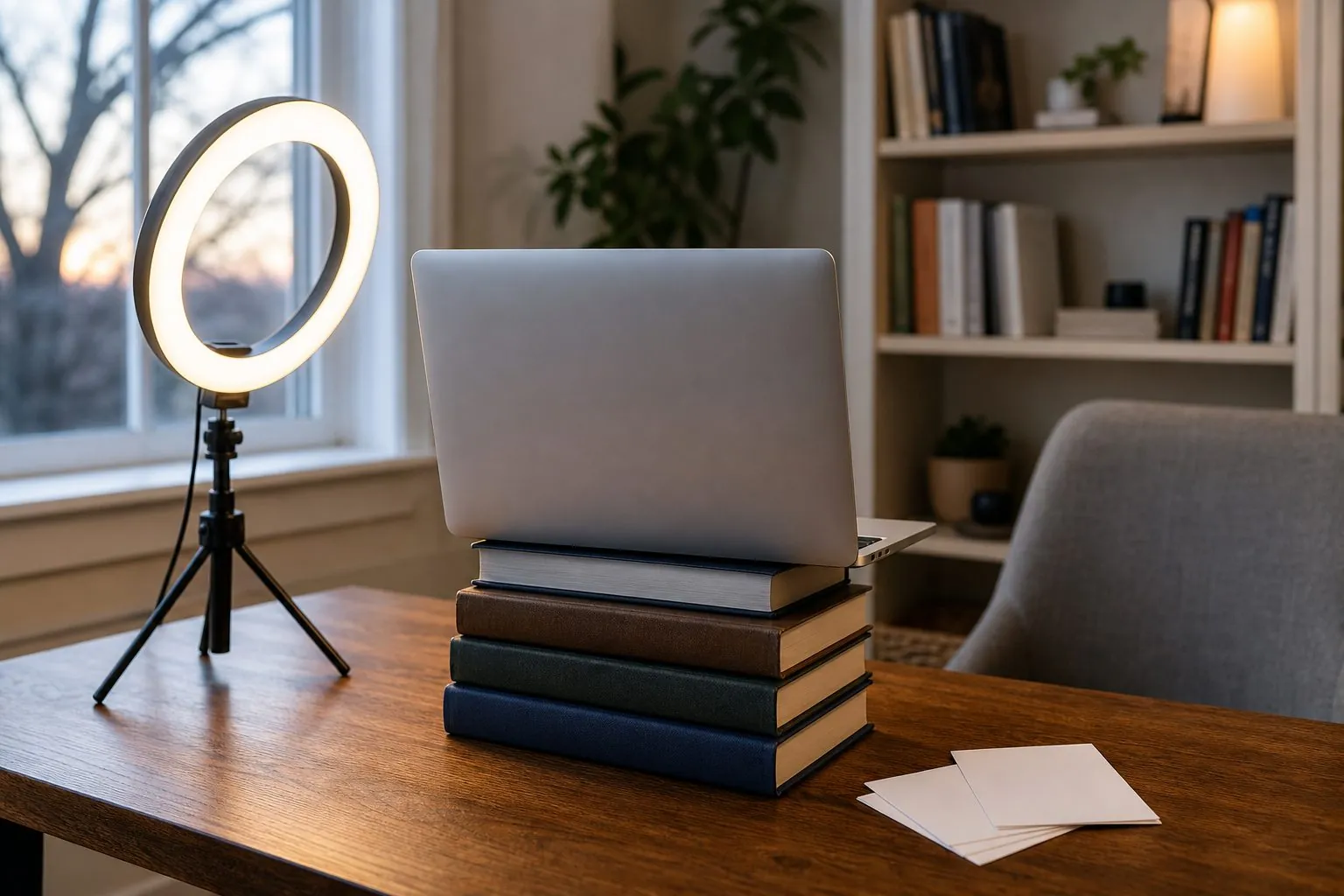
Here is how to practise a presentation alone: record one short take and watch it back three times, taking one channel away each time. Sound off, and you judge only your body. Picture off, and you judge only your voice. Then everything, to judge whether the argument lands. One viewing with everything switched on tends to collapse into a single verdict, usually about your voice. Three narrow viewings give you three short lists you can act on tomorrow. The whole routine takes about fifteen minutes and needs a phone, a stack of books and a pair of headphones.
Why watching yourself once doesn’t work
The first problem is the voice. When you speak, you hear yourself partly through the bones of your skull, which favour low frequencies, so the voice in your head sounds lower than the one others hear. A recording carries only the sound that travelled through the air. A team led from EPFL, writing in Royal Society Open Science, names that missing bone conduction as one of the main reasons a played-back voice sounds strange to its owner. The recording is closer to what the room hears. The flinch is about your skull, not your talk.
The second problem is bandwidth. One viewing asks you to watch your hands, count your “ums”, time your pace and follow your argument at once. Few people can. You judge whatever grabs you first and miss the rest.
Watching yourself back is still worth doing. A 2015 review of research on teaching presentation skills, by van Ginkel and colleagues, lists self-assessment through video among seven design principles, while noting that the studies behind it leave open questions. The fix is to narrow what you judge on each viewing.
Set up the frame before you rehearse
Two minutes of set-up saves you reviewing a take you can’t use: if your hands are out of shot, pass one has nothing to show.
Before you press record
- Lens at eye height. A laptop on a stack of books, or a phone on a shelf, about an arm and a half away.
- Head and both hands in frame. Step back until your hands are visible at rest and stay in shot when you gesture.
- Light in front of you. A window or lamp facing you, nothing bright behind.
- Stand if you will stand on the day. Use the same spot every time, so one day’s take compares with the next.
- Talk to the lens, not the preview. Hide your self-view if you can. Where to look on camera covers the rest.
Record yourself practising a presentation: one take, three minutes
Three minutes holds an opening, a middle and a close, and you can watch it three times in about ten minutes. Rehearse a longer talk in sections: the opening, the transition you always fumble, the close, the Q&A.
Speak from bullets, not a script, or the take becomes a reading. Start speaking as soon as the recording runs, and don’t restart. If you lose your place, recover as you would in the room: recovering is part of what you are rehearsing.
Pass 1: sound off, judge only your body
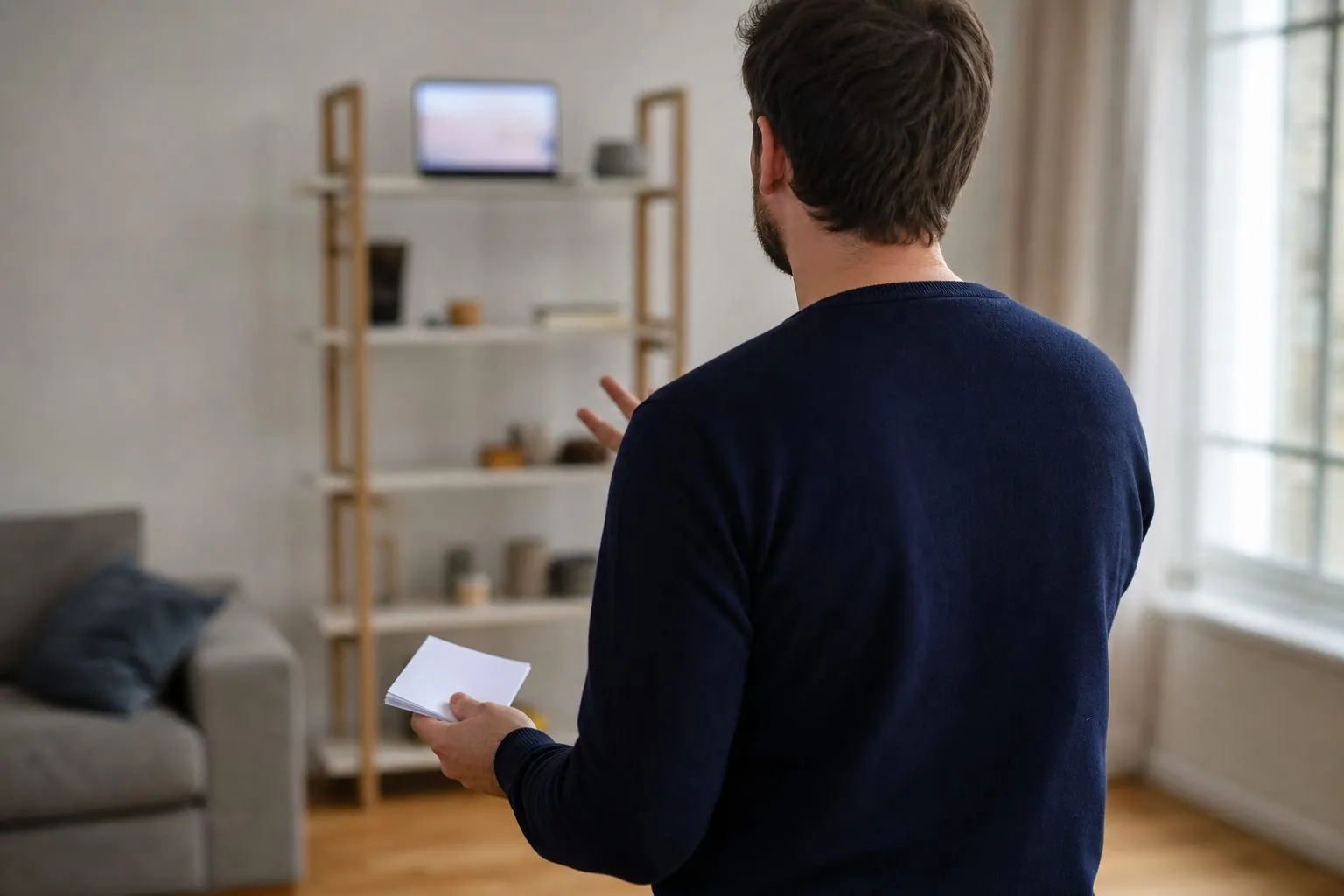
Mute the recording and watch it at normal speed. Without words, you see what an audience sees before they start listening.
| Look at | What to note |
|---|---|
| Hands | Visible, or hidden in pockets, clasped behind you or gripping the cards? |
| Gestures | Do they arrive with a point, or fidget: face touching, pen clicking? |
| Feet and posture | Planted, or swaying and shifting weight? |
| Eyes | On the lens, or down at your notes mid-sentence? |
Note two or three moments with their timestamps, no more. If your hands are the recurring note, the next step is what to do with your hands when you present.
Pass 2: picture off, judge only your voice
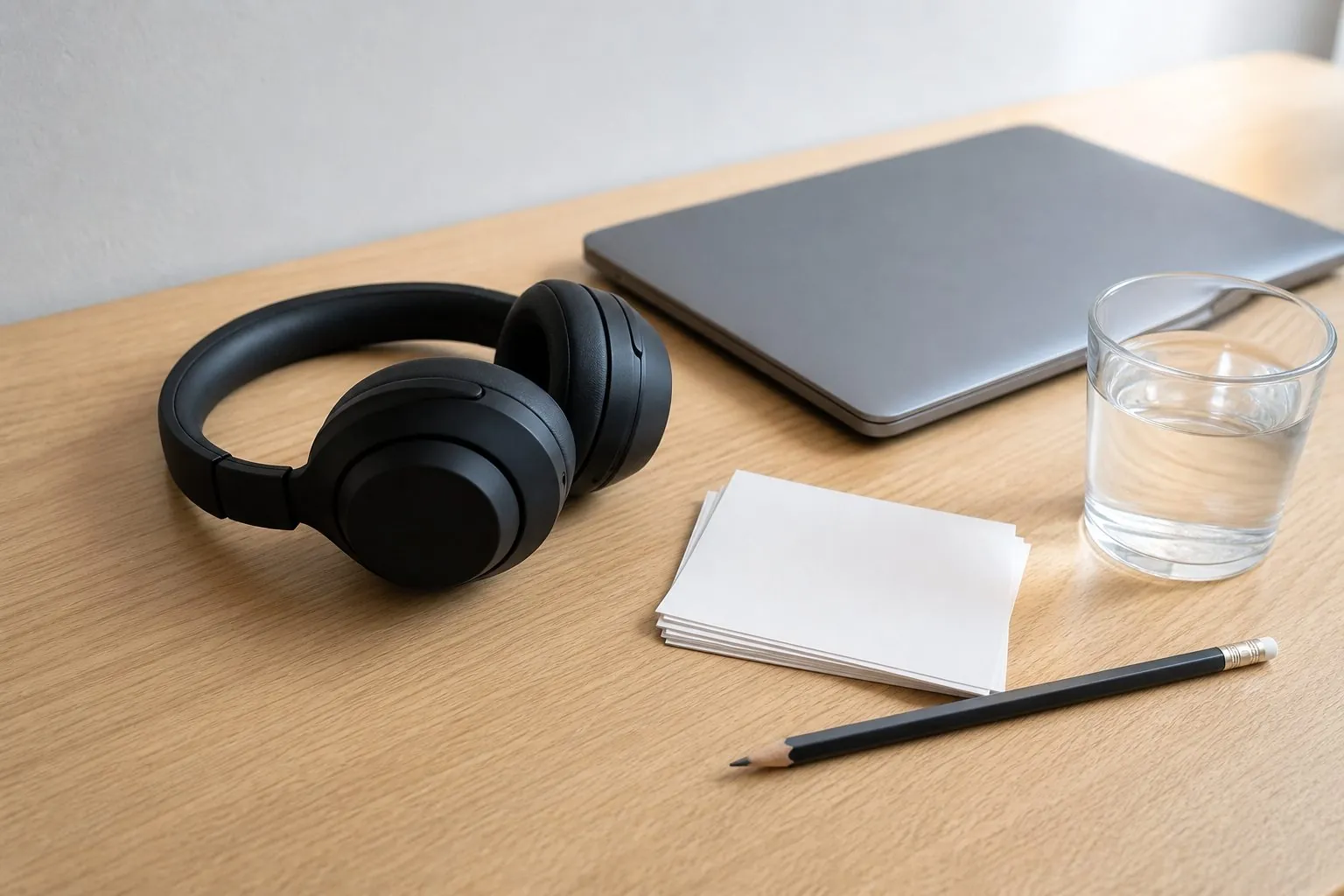
Put on headphones and turn the screen away. This is the pass where “I hate my voice” arrives; let it go. You are listening for four things, and timbre isn’t one of them.
| Listen for | What to note |
|---|---|
| Fillers | Tally every um, uh, “you know”, and any “so” that only starts a sentence. |
| Pace | Where you rush. Usually the parts you know best. |
| Pauses | Did you stop after the points that matter, or run straight on? |
| Pitch | Does your voice move, or does it flatten into one line? |
For a rough filler rate, divide the tally by your word count; StageMirror’s target is under 2%. If yours is high, try a pause for every “um”. If you rushed, see the right pace for a pitch.
Pass 3: everything, including structure
Sound and picture back on. This pass is for the argument, which nothing can count for you. Answer yes or no:
- Does the opening make its point in the first fifteen seconds?
- Is there one thread that everything serves?
- Could a listener name the structure: problem, what changes, what you want?
- Does it end on a decision, or trail off into “so, yeah”?
Then choose one fix for tomorrow and write it as a single sentence. One fix gets done. A list of seven gets read.
How to rehearse a pitch: three minutes a day beats an hour the night before
Spreading practice out is one of the most replicated findings in learning research. Cepeda and colleagues pooled 317 experiments on it, and John Dunlosky’s summary for teachers is plain: people retain knowledge and skills longer when they distribute practice than when they mass it. Cramming feels productive because material quickly feels familiar. Most of this research tests memory for words and facts, not delivery, so treat it as a strong hint.
So: one take a day, one fix a day, and the same words for a few days, so a change in the take comes from you rather than the script. With a date to hit, the two-week demo-day plan puts one skill on each day.
Doing the three passes in StageMirror
StageMirror is built around this loop, with the counting done for you. The studio stops a take at 3 minutes and gives you a 3-second countdown, framing guides (rule-of-thirds lines and a box for your eye line) and a teleprompter that scrolls on its own, at one of three speeds you pick on the web. It doesn’t follow your voice.
The free 14-Day Founder Speaker Intensive starts the same way. Day 1, “Your uncoached baseline”, has you set the frame, write your pitch as bullets and record 60 seconds without managing anything, so later days have a number to beat. If you are comparing tools, here is what to ask any AI public speaking coach before you trust its score.
Frequently asked questions
How can I practise a presentation without an audience?
Record a short take and review it in three passes: sound off for your body, picture off for your voice, then everything for the structure. The camera stands in for the audience.
How many times should I rehearse a presentation?
There is no reliable magic number. Learning research favours several short sessions spread over days to one long one, so a short take each day, one fix at a time, beats run-throughs the night before.
Should I memorise my presentation word for word?
Usually not. Speak from bullets so you sound like yourself and your eyes stay up. Learning the first and last sentences exactly is worth it, because a stumble shows most there.
Why do I hate the sound of my voice on recordings?
When you speak, you hear yourself partly through bone conduction, which emphasises low frequencies, so your voice sounds lower in your head than it does to others. A recording has only the airborne sound, which is closer to what your audience hears.
Is it better to practise in front of a mirror or on camera?
On camera. In a mirror you speak and watch at once, and there is nothing to replay. A recording lets you speak first and judge afterwards, one channel at a time.
Sources
- Bone conduction facilitates self-other voice discrimination — Orepic, Kannape, Faivre and Blanke, Royal Society Open Science 10: 221561, 2023
- Towards a set of design principles for developing oral presentation competence: A synthesis of research in higher education — van Ginkel, Gulikers, Biemans and Mulder, Educational Research Review 14, 62–80, 2015
- Strengthening the Student Toolbox: Study Strategies to Boost Learning — John Dunlosky, American Educator (American Federation of Teachers), 2013
- Distributed Practice in Verbal Recall Tasks: A Review and Quantitative Synthesis — Cepeda, Pashler, Vul, Wixted and Rohrer, Psychological Bulletin 132(3), 354–380, 2006